Birthstones by month
Birthstones by month: every month's stone, from garnet in January to tanzanite, turquoise and zircon in December, as the American Gem Society lists them. Pick a month above to see its stones; it opens on this month. Below is the birthstone chart, how hard each stone is and which ones are the same mineral, with facts from the Gemological Institute of America.
All 12 months
The stones for each month, including the six months that have two or three to choose from.
What each stone is
Its mineral, its colors and its hardness on the Mohs scale, in GIA's own terms.
With birth flowers
Each month's page also gives its birth flowers and the zodiac signs of a birthday that month.
Birthstone chart
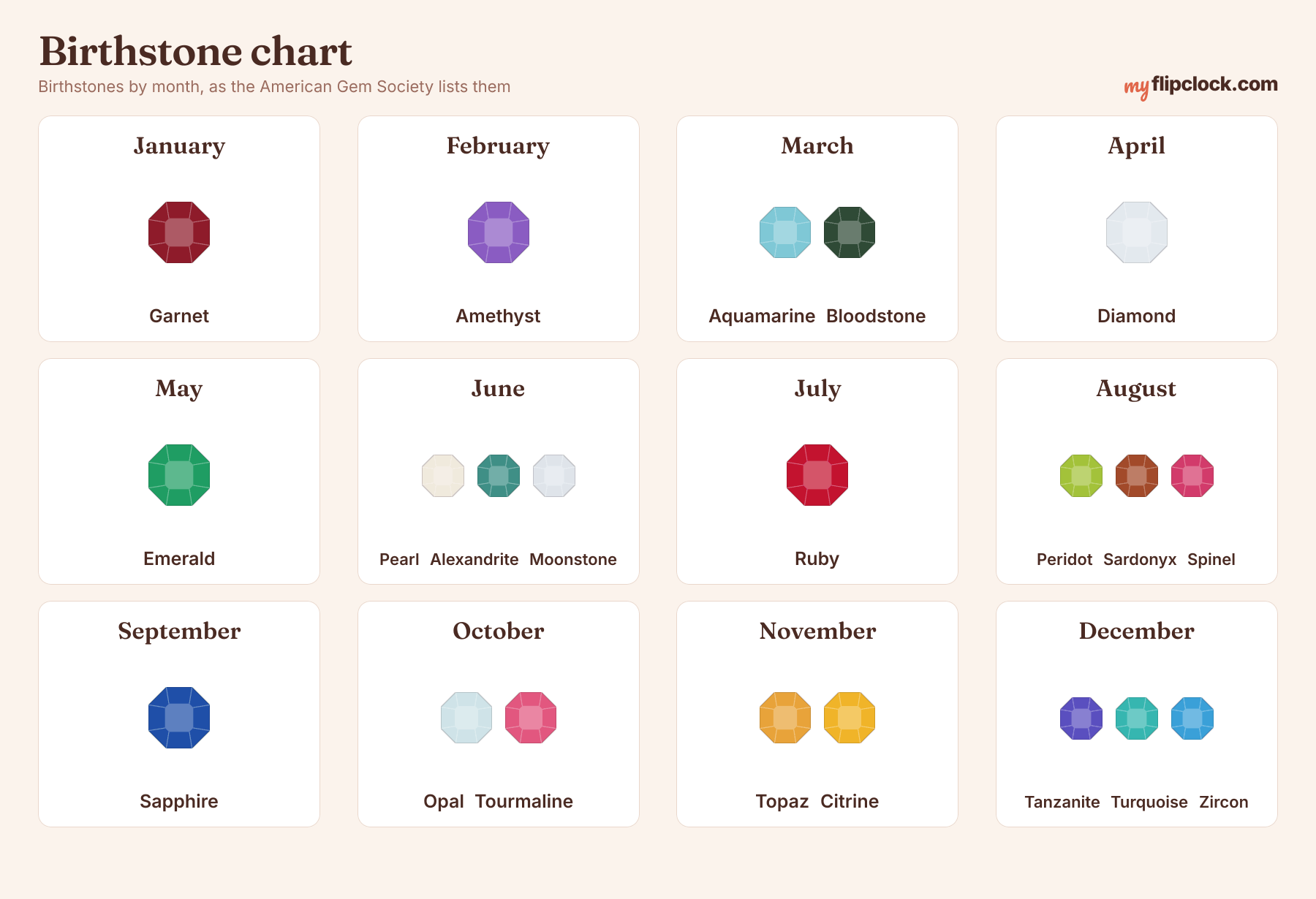
| Month | Birthstone | Colors (GIA) | Birth flower |
|---|---|---|---|
| January | Garnet | garnet: all colors | Carnation and Snowdrop |
| February | Amethyst | amethyst: purple | Violet and Primrose |
| March | Aquamarine and Bloodstone | aquamarine: greenish blue, light in tone; bloodstone: dark green with red spots | Daffodil |
| April | Diamond | diamond: colorless | Sweet pea and Daisy |
| May | Emerald | emerald: vibrant green | Lily of the valley and Hawthorn |
| June | Pearl, Alexandrite and Moonstone | pearl: white, black, gray, yellow, orange, pink, lavender, green and blue; alexandrite: bluish green in daylight, purplish red in incandescent light; moonstone: colorless to white, gray, green, peach and brown | Rose and Honeysuckle |
| July | Ruby | ruby: red | Larkspur and Water lily |
| August | Peridot, Sardonyx and Spinel | peridot: yellowish green; sardonyx: reddish with white bands; spinel: red, orange, pink, purple, blue and black | Gladiolus and Poppy |
| September | Sapphire | sapphire: every color but red | Aster and Morning glory |
| October | Opal and Tourmaline | opal: all colors; tourmaline: all colors | Marigold and Cosmos |
| November | Topaz and Citrine | topaz: yellow, orange, brown, pink to red to purple red, blue, light green and colorless; citrine: yellow to orange to orangy red | Chrysanthemum |
| December | Tanzanite, Turquoise and Zircon | tanzanite: violet blue to bluish violet to violet purple; turquoise: blue to green; zircon: blue, red, yellow, orange, brown and green | Holly and Narcissus (paperwhite) |
The birthstone colors by month are as GIA describes each stone, except bloodstone and sardonyx, which are described from the American Gem Society, since GIA has no page for either.
Months with more than one birthstone
6 months have a choice. June, August and December each have three birthstones, and March, October and November have two. Any stone on a month's list counts as its birthstone. According to the American Gem Society, August became a three-stone month in 2016; sardonyx was its original birthstone.
Birthstones from hardest to softest
Hardness on the Mohs scale measures how well a stone resists scratching, from 1 to 10. A stone low on the scale needs more care in a ring worn every day. These are GIA's figures; bloodstone and sardonyx have none.
| Stone | Mohs hardness | Month |
|---|---|---|
| Diamond | 10 | April |
| Ruby | 9 | July |
| Sapphire | 9 | September |
| Alexandrite | 8.5 | June |
| Spinel | 8 | August |
| Topaz | 8 | November |
| Aquamarine | 7.5 to 8 | March |
| Emerald | 7.5 to 8 | May |
| Tourmaline | 7 to 7.5 | October |
| Garnet | 6.5 to 7.5 | January |
| Zircon | 6 to 7.5 | December |
| Amethyst | 7 | February |
| Citrine | 7 | November |
| Peridot | 6.5 to 7 | August |
| Tanzanite | 6 to 7 | December |
| Moonstone | 6 to 6.5 | June |
| Opal | 5 to 6.5 | October |
| Turquoise | 5 to 6 | December |
| Pearl | 2.5 to 3 | June |
Birthstones that are the same mineral
Several birthstones are one mineral in different colors, by GIA's classification:
- Quartz: amethyst (February) and citrine (November)
- Beryl: aquamarine (March) and emerald (May)
- Corundum: ruby (July) and sapphire (September)
Garnet is the name of a whole group of related minerals, which is why it comes in every color. Pearl is an organic gem, made by a living mollusk.
How to use it
- Pick a month with the buttons under the stones. The page opens on the current month.
- Read its stones in a color close to each one's best-known.
- Open the month for what each stone is, its hardness, and that month's birth flowers and zodiac signs.
Questions
What are the birthstones by month?
January: garnet. February: amethyst. March: aquamarine and bloodstone. April: diamond. May: emerald. June: pearl, alexandrite and moonstone. July: ruby. August: peridot, sardonyx and spinel. September: sapphire. October: opal and tourmaline. November: topaz and citrine. December: tanzanite, turquoise and zircon.
Who decides the birthstones?
The list on this page is the one the American Gem Society publishes. Lists differ a little: the Gemological Institute of America's own chart gives August as peridot and spinel, without sardonyx, and GIA's tanzanite page names blue topaz as a December birthstone too.
Which birthstone is the hardest?
Diamond, April's birthstone, at 10 on the Mohs scale. Ruby and sapphire, July's and September's, come next at 9. The softest is pearl, one of June's three, at 2.5 to 3.
Which months have three birthstones?
June (pearl, alexandrite and moonstone), August (peridot, sardonyx and spinel) and December (tanzanite, turquoise and zircon).